
How is an egg donor approved?
Egg donation is a responsible and important step. For this reason, every applicant is carefully assessed before she can be approved as an egg donor with us.
Our aim is to safeguard both the donor’s health and the safety of the treatment as thoroughly as possible.

Who can become an egg donor?
To be approved as an egg donor, an applicant must meet certain requirements.
An egg donor:
must be between 18 and 35 years old,
must be in good general health,
must have a BMI below 30,
must not have any known genetic or hereditary conditions,
must not have any known serious or hereditary conditions in her immediate family.
In addition, the donor must not be adopted or have been conceived through donation, as a sufficiently complete genetic family history is necessary for the medical assessment.
Detailed medical and family history
An important part of the approval process is a thorough assessment of the applicant’s personal and family medical history.
The applicant is asked about both her own health and any medical conditions in her family. The family history covers several generations and helps us assess whether there are any indications of possible hereditary conditions.
If there is any uncertainty about a condition in the family, or whether it could be relevant in relation to egg donation, we always discuss the individual case with a geneticist.
Only after this genetic assessment do we decide whether the applicant can be approved as an egg donor or whether she must be excluded.
Medical examination
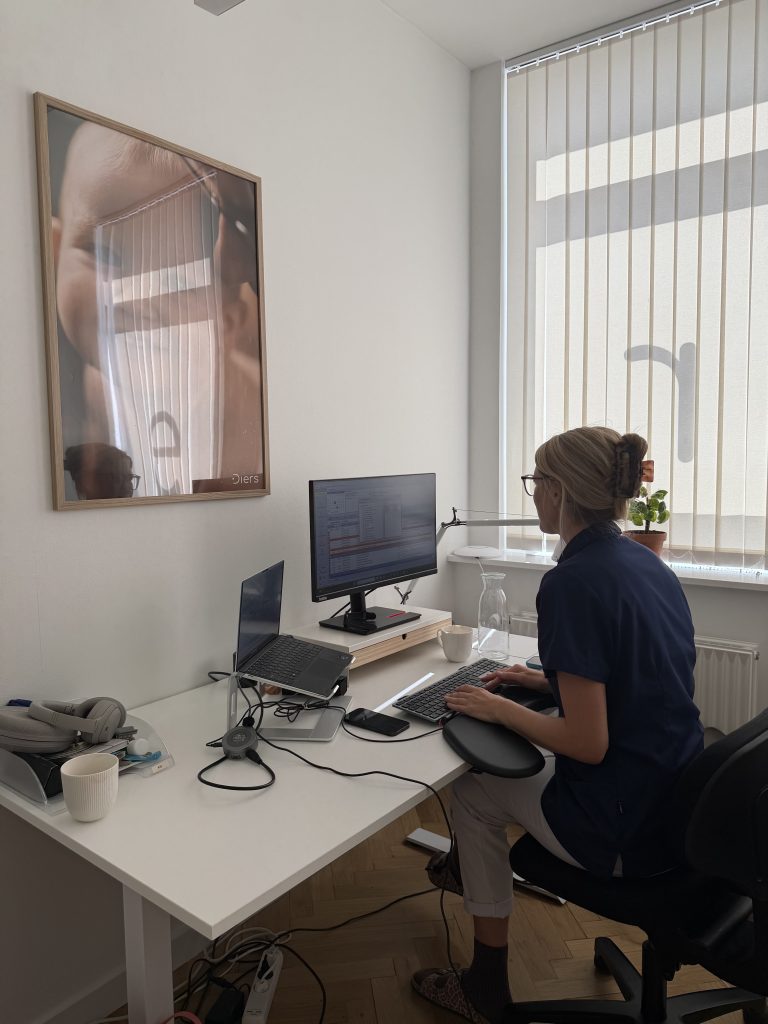
Before approval, every egg donor undergoes a medical examination.
This assessment considers whether there are any medical factors that could make egg donation or the hormonal stimulation required for the process unsuitable.
Only after a careful medical assessment can the applicant be approved as an egg donor
Screening for infectious diseases
All egg donors are screened for relevant infectious diseases:
HIV
Hepatitis B
Hepatitis C
Syphilis
Chlamydia
Gonorrhoea
These tests are carried out both to protect the recipient and to ensure the safety of the treatment.
Genetic screening of our egg donors
All our egg donors undergo genetic testing before they are approved.
The screening includes, among other things:
Cystic fibrosis (CF)
Spinal muscular atrophy (SMA)
Chromosome analysis (karyotyping)
Screening for 30 X-linked genetic conditions
Together with the detailed family medical history, this screening helps us identify known genetic risks as far as possible and take them into account when selecting a donor.
If the family history or test results raise any questions, the case is also reviewed from a genetic perspective before the donor receives final approval.
GeneMatch – for every egg donation treatment
As part of every egg donation treatment, we always carry out a GeneMatch.
Everyone carries genetic variants that usually have no impact on their own health.
However, with recessively inherited conditions, there may be a risk to a child if both the egg donor and the genetic father or sperm donor carry a disease-causing variant in the same gene.
If only one of the two genetic contributors carries such a variant, the child will generally not develop the corresponding recessive condition.
With GeneMatch, we therefore compare the genetic results of the egg donor with those of the genetic father or the selected sperm donor from Diers Selected.
This allows us to avoid matching an egg donor with a genetic father or sperm donor when both carry a relevant disease-causing variant in the same gene.

Getting to know our donors personally
We know our egg donors personally.
For this reason, the selection process is not based solely on medical test results.
We also speak with each applicant in detail about her motivation for donating and what egg donation may mean for herself, the recipient and the future child.
It is important to us that the decision to donate is made consciously and on the basis of clear and thorough information.
A donor is only approved after the full assessment is complete
An applicant is only approved as an egg donor once all required medical examinations, blood tests, genetic tests and assessments have been completed and there are no reasons why she should not donate.
Only then can she be added to our database and become available for selection for an egg donation treatment.
The egg donor can decide for herself when she wishes to make her first donation.
Under Danish law, an egg donor may donate a maximum of six times.
Can screening rule out every condition?
No.
Even a very thorough medical and genetic assessment cannot rule out the possibility that a person carries a previously unknown condition or genetic variant, or may develop a medical condition later in life.
Screening and GeneMatch can reduce known genetic risks, but they cannot guarantee the health of a future child.
This limitation applies to all forms of medical and genetic testing.

Do you have questions?
If you have any questions about how our egg donors are approved, or if there is anything else you would like to know, please feel free to contact us.
We are always happy to answer your questions.